
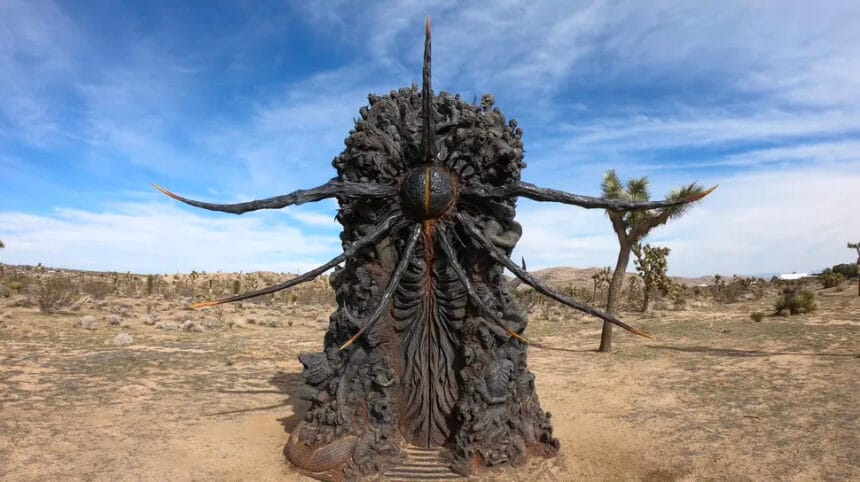
A strange, spiked monolith covered in demonic carvings—and proudly displaying a giant, unblinking eye—has appeared in the Mojave Desert. It’s clearly teasing something for The Game Awards 2025. And thanks to a handful of new trademark filings, it looks like we already know what that “something” is: a brand-new game from Larian Studios titled Divinity.
If your first introduction to Larian was the runaway success of Baldur’s Gate 3, the name Divinity might not mean much. But longtime fans know that BG3 stands on the foundation of Larian’s earlier work—the Divinity series, which spans six games released between 2002 and 2017. If the Mojave teaser and the trademarks are genuine clues, Larian may be steering back to the fantasy universe it spent more than a decade building… and it’ll be bringing millions of new players with it.
So if this possible new project ends up being your first visit to the world of Divinity, here’s a quick crash course.
Welcome to Rivellon
Like how Baldur’s Gate lives inside Dungeons & Dragons’ Forgotten Realms, Divinity takes place in its own homegrown setting: Rivellon.
At a glance, Rivellon shares familiar fantasy roots—lush medieval landscapes, classic races (humans, dwarves, elves, reptile-folk, the undead), and plenty of magic. Sorcery, however, is treated as volatile and dangerous, giving the world a slightly sharper edge than standard high fantasy.
But Rivellon isn’t all grim prophecy and ancient evils. The setting has always had a quirky streak, tilting into steampunk or sci-fi elements when it feels like it, and occasionally indulging in outright silliness. Terry Pratchett’s Discworld has been a clear touchstone for the series’ writing, and his daughter Rhianna even authored a tie-in novella for the second game. Still, beneath the humor lies a deep, complex lore built across all six titles.
In short: it scratches many of the same itches as Baldur’s Gate 3, but in a universe entirely shaped by Larian rather than the rulebooks of Wizards of the Coast.
What Exactly Is Divinity?
The Divinity series is an RPG line with a history that refuses to sit still. Across six games, Larian has tried:
- Action RPGs inspired by Diablo (Divine Divinity, Beyond Divinity)
- A third-person story-driven RPG (Divinity 2: Ego Draconis)
- A strategy/RTS hybrid (Divinity: Dragon Commander)
- Classic turn-based CRPGs (Original Sin and Original Sin 2)
With such variety, there’s no guarantee what form the next game will take. That said, considering the global impact of Baldur’s Gate 3, many would bet on something in that style.
The timeline is also unusual. Rivellon’s history is coherent, but each game is set years—or centuries—apart. None of the titles require prior experience, and you can jump in anywhere, much like players could enjoy BG3 without touching the earlier Baldur’s Gate games. If the new project truly carries the simple title Divinity, that’s likely intentional: clean, inviting, and not intimidating to newcomers.
Why the Name “Divinity”?
The title ties back to Rivellon’s core mythology. Long before any of the games take place, the Council of Seven sacrificed themselves to save the world from rogue sorcerers. Their legacy formed the “Divine Order”, a group charged with safeguarding Rivellon.
By the time of the first game, a prophecy foretells the coming of a champion destined to face a demonic threat known as Chaos. That hero is the player character, who ultimately ascends as Lucian the Divine—a figure whose influence echoes through later games and whose name shaped the franchise.
The idea of “the Divine” isn’t the focus of every game, but it’s a recurring pillar of the universe.
How Close Is Divinity to Baldur’s Gate 3?
Most of the older Divinity titles bear little resemblance to BG3. But the Original Sin games, especially Original Sin 2, are unmistakably the DNA that BG3 was built from:
- Isometric exploration
- Turn-based tactical combat
- Open-ended quest design
- Rich dialogue systems with character-specific options (“tags”)
- Origin characters that later inspired BG3’s companions
One of the most beloved mechanics in Original Sin is its elemental interaction system—puddles become electrified, oil becomes infernos, blood turns to ice and becomes a hazard, and so on. BG3 borrowed this idea but toned it down; in Original Sin 2, it often becomes a battlefield-wide fireworks show.
Where to Start With the Divinity Games
You can play the series in almost any order thanks to the large time gaps. If you’re just curious after finishing BG3, the must-play entry is Divinity: Original Sin 2, available on PC, PlayStation, Xbox, Switch, and even iPad.
For those who want the full chronological tour, here’s the recommended timeline:
- Divinity: Dragon Commander (2013) – A large-scale strategy game set millennia before the RPGs.
- Divinity: Original Sin (2014) – A CRPG set 1,000 years before the first game, following two Source Hunters.
- Divine Divinity (2002) – An ARPG where players rise to become Lucian the Divine.
- Beyond Divinity (2004) – A direct follow-up, 20 years later, focused on a character bound to a Death Knight.
- Divinity: Original Sin 2 (2017) – A masterpiece in Larian’s catalog, set after the original two titles.
- Divinity 2: Ego Draconis (2009) – A third-person RPG where you play a dragon-shifting knight during a new era of turmoil.